
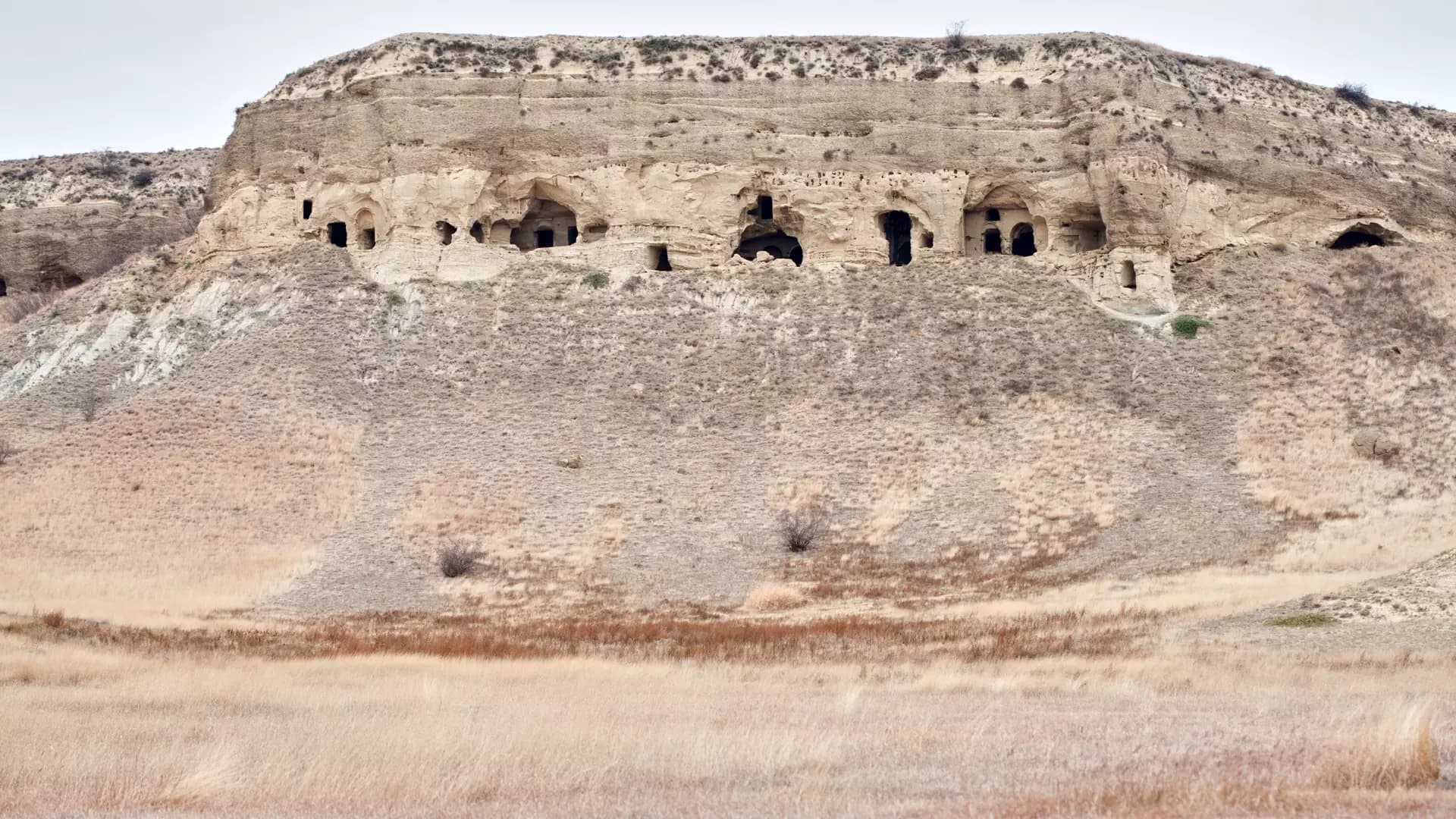
Udabno Monastery
Guria
Perched on the steep slopes of Amaghleba Mountain in Chokhatauri Municipality, Udabno Monastery of St. John the Baptist is one of the oldest and most extraordinary monastic sites in western Georgia. Despite its name, which means "desert" in Georgian, the monastery is surrounded by dense forests, natural springs, and breathtaking mountain scenery. Here, the word Udabno refers not to a barren landscape, but to the secluded life of monks who sought silence, prayer, and spiritual devotion far from the outside world.
The heart of the monastery is a remarkable 6th-century rock-hewn church, partially carved directly into the cliff. It is considered one of the oldest surviving cave churches in western Georgia and remains a rare example of early Georgian Christian architecture. Nearby caves once served as chapels and monastic cells, preserving the atmosphere of one of Guria's earliest spiritual communities.
For centuries, Udabno was not only a place of prayer but also an important center of education and manuscript production. Monks copied religious texts, translated theological works, and maintained a renowned library. Among its greatest treasures was the "Udabno Mravaltavi", a remarkable 9th-century manuscript regarded as one of the most valuable works of medieval Georgian literature. Although many priceless manuscripts and icons were lost during the Soviet era, the monastery remains a powerful symbol of Georgia's cultural and spiritual resilience.
Today, the restored St. John the Baptist Men's Monastery continues its centuries-old monastic tradition. Visitors are rewarded not only with a profound sense of peace but also with spectacular panoramic views over southern Guria, making Udabno one of the region's most inspiring pilgrimage and cultural destinations.
Back to Guria